
FortuneJack provably fair play comes from third-party crash and instant titles
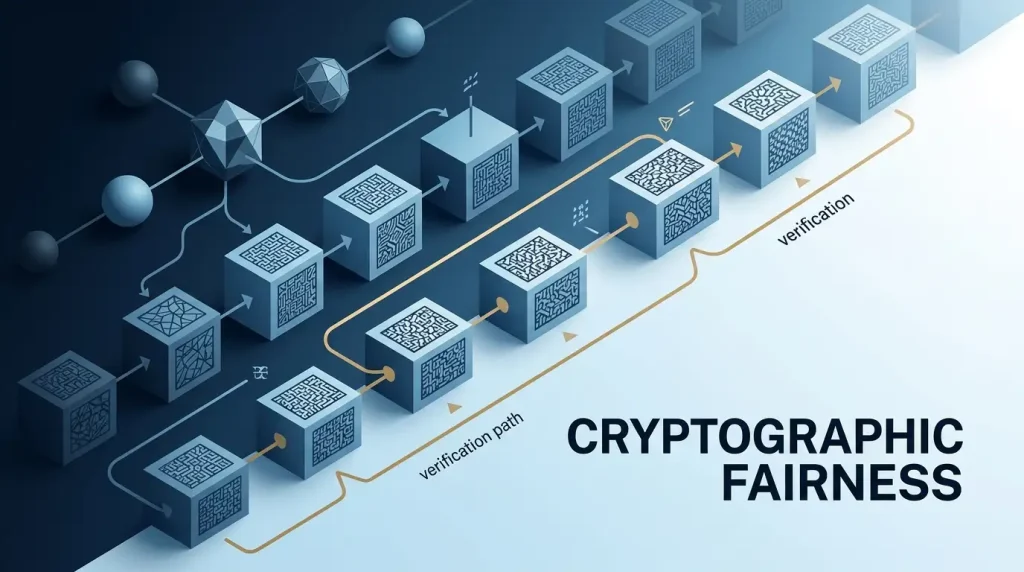
Table of Contents
- The brand-specific claim is narrow and clear
- Seeds and hashes create a commitment that can be checked later
- A round check follows a simple sequence when the game exposes the inputs
- Fairly produced results can still carry house edge and severe variance
- Third-party provably fair titles shift the verification focus to the game provider
- Use verification as one checkpoint in a wider risk routine
- Questions readers ask about FortuneJack provably fair games
- Verification is valuable when it stays separate from claims about profitability
Section element
Cryptographic verification for selected third-party games
FortuneJack is reported to carry third-party crash and instant games with provably fair mechanics, while no in-house Originals line is reported. That distinction matters because the verification method belongs to the individual game or provider: provably fair can help check how a result was produced, but it does not by itself prove that a game is profitable, low-risk or free of house edge.
The brand-specific claim is narrow and clear
FortuneJack has third-party crash and instant games that use provably fair mechanics. No in-house Originals are reported. That is the useful boundary for evaluating the feature: the casino carries games with a cryptographic verification layer, but the evidence does not support describing FortuneJack as an operator with its own proprietary provably fair game suite.
- Provably fair playAvailable in third-party crash and instant titles
- In-house OriginalsNone reported
- Verification scopeIndividual game or provider mechanics
The wider FortuneJack games guide explains how these titles sit beside slots and live casino. If you are comparing live-streamed formats instead, the live casino guide covers that separate category.
Seeds and hashes create a commitment that can be checked later
A typical provably fair design uses cryptographic inputs before or during a round. The exact implementation varies by game, but the core idea is that at least part of the outcome process is committed in a way that can later be checked. Common systems use a server seed, a player or client seed, a nonce and a cryptographic hash.
Server seed
A secret value controlled by the game side. A hash of this seed can be shown before play so the underlying value cannot be quietly replaced later without changing the hash.
Client seed
A value associated with the player side of the calculation. Some systems let the player change it, which helps prevent the final result from depending on a server-side input alone.
Nonce
A counter or round index that changes between outcomes so repeated use of the same seed pair can still create distinct results.
Hash
A one-way cryptographic fingerprint. It lets a player compare a revealed seed with the commitment that was displayed before the result was known.
The important idea is commitment before revelation. If the game publishes a hash first and reveals the underlying seed later, the player can hash the revealed value and compare it with the earlier commitment. A match shows that the committed input is the same one later disclosed.
That mechanism can be powerful, but only within its defined scope. It verifies consistency between inputs and the stated algorithm. It does not automatically audit every other part of the casino experience.
A round check follows a simple sequence when the game exposes the inputs
Verification should be repeatable rather than mystical. A player should be able to identify the committed value, see the inputs used for the round, reproduce the disclosed calculation and compare the expected output with the actual result. The interface can vary, but the logic is straightforward.
- Record the pre-round hash or commitment shown by the game before the relevant seed is revealed.
- After the seed is disclosed or rotated, compare its hash with the original commitment.
- Identify the client seed, nonce and any other inputs the game says are part of the outcome calculation.
- Use the game’s verifier or reproduce the disclosed formula independently where the inputs and algorithm are available.
- Compare the calculated result with the round outcome shown in the game history.
If those values line up, the player has evidence that the round was produced from the committed inputs under the stated method. If the game does not expose enough information to reproduce the check, the label alone offers less practical transparency.
| Element | What it can show | What it cannot show by itself |
|---|---|---|
| Pre-round hash | The later-revealed seed matches an earlier commitment. | Whether the game has a favorable expected return. |
| Client seed | Player-side input can be part of the calculation. | That every implementation detail is free from error. |
| Nonce | Distinct rounds can be tied to distinct counters. | That a short session will resemble long-run averages. |
| Verifier | The disclosed calculation can be reproduced. | That volatility or house edge disappears. |
Fairly produced results can still carry house edge and severe variance
Provably fair and favorable are not synonyms. A game can produce every round exactly according to its published cryptographic process and still be designed with a house edge. That means the long-run expected loss can remain negative for the player even when the outcome generation is transparent.
Variance is separate again. In a short sequence of bets, results can swing far above or below the mathematical expectation. A verification tool can show that a given round followed the committed process, but it cannot predict whether the next ten, hundred or thousand rounds will be profitable.
What provably fair can help establish
- The committed seed matches the revealed seed.
- The disclosed inputs reproduce a stated round result.
- The outcome process is more inspectable than a pure black box.
What still needs separate judgment
- House edge and payout structure.
- Session volatility and loss limits.
- Payment handling, account checks and withdrawal conditions.
Those separate questions are why gambling risk should never be collapsed into one technical label. For transaction handling, the FortuneJack payments guide covers supported coins, networks and fee treatment without treating payment mechanics as evidence about game fairness.
Third-party provably fair titles shift the verification focus to the game provider
No in-house Originals are reported for FortuneJack. The provably fair component therefore sits with third-party crash and instant titles rather than a proprietary FortuneJack game family. That changes where the reader should look for verification instructions: the relevant seed, hash and verifier information belongs to the individual game or its provider implementation.
This separation also prevents a common conceptual mistake. A casino can host many games from different studios, each with its own mathematics and fairness system. One provider’s verifier does not automatically describe another provider’s implementation. Treat each game as its own technical object.
- Casino role
- Provides access to the third-party title inside the wider game catalogue.
- Provider role
- Supplies the game logic and, where implemented, the provably fair verification mechanism.
- Player task
- Use the verifier and inputs for the specific game rather than assuming one universal FortuneJack method.
That distinction is practical rather than academic. If a game offers a seed history or verification panel, those are the materials to inspect. A general “provably fair” label is less useful than a repeatable check on the exact round you played.
Use verification as one checkpoint in a wider risk routine
A technically correct verification process can improve transparency, but gambling decisions still need basic risk controls. The strongest routine is to combine outcome verification with clear staking limits, careful reading of the paytable and a willingness to stop when the session no longer matches the amount of money you intended to risk.
- Confirm that the game exposes a verifier or enough inputs to reproduce the check.
- Keep the pre-round commitment if you want to validate the revealed seed later.
- Read the paytable or game rules separately from the fairness explanation.
- Do not interpret a successful verification as evidence that losses should reverse.
- Stop when the amount at risk exceeds the limit you set before the session.
The hub also includes a theoretical-loss checker that models how stake size, number of bets and an illustrative house edge interact. Its output is a scenario, not a FortuneJack game parameter or prediction, and it reinforces the same point: verification does not remove expected-loss mechanics or variance.
Questions readers ask about FortuneJack provably fair games
Does FortuneJack have provably fair games?
FortuneJack is reported to carry third-party crash and instant titles that use provably fair mechanics.
Does FortuneJack operate its own Originals?
No in-house Originals are reported. The useful brand-specific fact is the availability of third-party provably fair titles.
What does a successful verification prove?
It can show that the disclosed inputs and disclosed algorithm reproduce the round result or match an earlier cryptographic commitment.
Does provably fair mean there is no house edge?
No. Outcome verification and game economics are separate. A game can be verifiable while still carrying a house edge and high variance.
Verification is valuable when it stays separate from claims about profitability
FortuneJack’s provably fair offering is limited to reported third-party crash and instant titles, with no in-house Originals line reported. The feature is useful because cryptographic commitments can make round generation more inspectable. Its limit is equally important: a successfully checked result can still come from a game with house edge, large variance and real loss risk. Use provably fair as a technical check, not as a reason to increase stakes or expect a favorable outcome.